
America doesn’t have a plan. What we have is a patchwork of laws and policies created by politicians pulled in two directions at once — by the voters who elect them and the special interest groups that bankroll their campaigns — running on two-to-four year cycles while the problems that matter run on decades. The result isn’t governance. It’s a collision of competing interests pulling in different directions rather than finding usable solutions. Nothing gets finished before the next election cycle begins and resets everything.
Citizen-Led Solutions
The solution is for citizens to work together — organized around real problems, deliberating toward real solutions, holding power accountable for real results. Not waiting for the next election. Not starting over when the last one doesn’t go the way it should. Staying in it, together, for as long as it takes. This is how democracy should work.
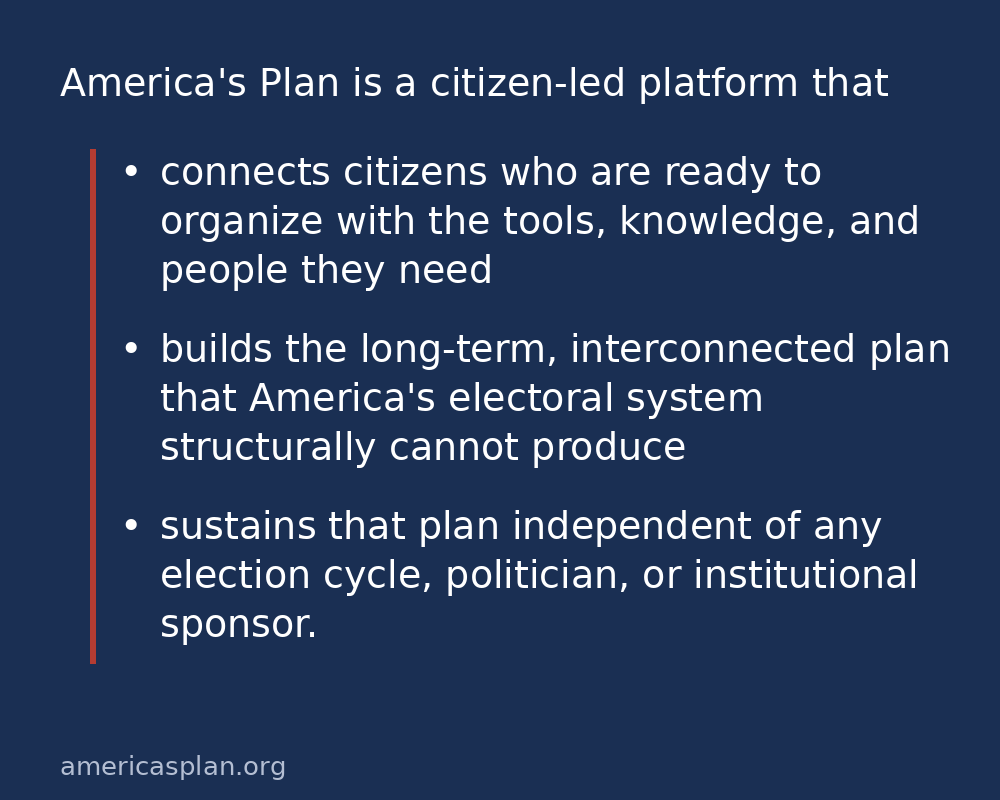
America’s Plan is the result of that work — a living, growing body of citizen-driven solutions to America’s social and political problems, built through public deliberation, organized around, advocated for, and tracked to delivery. Not a fixed agenda handed down from above. Not a list of predetermined answers. The plan that emerges when citizens stay organized long enough to actually finish something.
And it changes nothing about how government works. It works entirely within the existing system — federal, state, and local — by changing the input government receives: giving ordinary people the same serious, organized channel that concentrated interests already have.
How It Works
You can take part on your own time and on your own terms:
- Learn — come understand an issue that matters to you
- Connect — find other people who care about the same thing
- Deliberate — work it out together and turn it into an actual solution
- Advocate — build public support for that solution
- Represent — carry it to the people who represent us
- Follow up — track it after implementation to make sure it holds.
It all happens in two open spaces: a public Forum, where people living with a problem work it out together, and a Wiki, where what gets worked out is kept so nothing starts over from scratch.
Help Build It
We’re in the early stages. The thinking is documented, the infrastructure is here, and the ideas are ready — but a project like this needs people. Right now we’re looking for builders: people willing to pick an issue they care about, help shape how America’s Plan grows, and take on early roles as facilitators and moderators.